What should you do when anxiety makes you skip class?
Why anxiety can turn one missed class into an avoidance loop, how to make a smaller return, and when campus or professional support can help.

- Skipping can bring immediate relief, which may teach anxiety that avoidance was the thing that kept you safe.
- The useful first step isn’t “try harder”; it’s identifying the exact moment, prediction, or barrier that makes attendance feel impossible.
- A smaller return, clear academic communication, and professional support can prevent one missed class from becoming a semester-sized secret.
- Severe symptoms, inability to care for yourself, or thoughts of self-harm need prompt help, not an attendance strategy.
Your alarm went off at 8:10 a.m. You’re dressed, your backpack is zipped, and the class is eight minutes away. Then your chest tightens. You picture walking in late, choosing a seat, being called on, and everyone noticing whatever anxiety says is unhideable. At 8:52 a.m., you’re still on the bed reading the attendance policy like it’s a ransom note.
One missed class doesn’t define your semester. The trouble starts when relief teaches your brain that staying away prevented disaster. By the next meeting, you’ve got the original fear plus shame, missing notes, and the belief that returning now will be even more obvious.
Avoidance works quickly, which is exactly the problem
When you decide not to go, anxiety may drop. That relief is real. It’s also powerful learning: your brain pairs escape with safety. Research on anxiety and avoidance suggests that repeated avoidance can keep feared predictions from being tested and may narrow what feels possible over time.
This doesn’t mean all avoidance is irrational. Staying home when you’re contagious, too impaired to drive, or facing an actually unsafe situation can be sensible. The question is what the absence is doing. Is it protecting health and safety, or protecting a frightening prediction from contact with reality?
Exposure-based treatments don’t ask people to become fearless before acting. They help people approach meaningful situations in planned, manageable ways and learn that anxiety can rise and fall without running the whole schedule. The goal isn’t to win a suffering contest. It’s to build new evidence.
“Class” may be hiding five different fears
Don’t stop at a broad label like “anxious about class.” Find the scene where the plan breaks. Is it leaving your room, crossing campus, entering late, sitting where you can’t easily leave, speaking, seeing classmates after an absence, taking a quiz, or admitting that you’re behind?
Some students fear panic symptoms. Some expect humiliation or judgment. Some are overwhelmed by unfinished work. Others are depressed, exhausted, using substances, managing trauma reminders, struggling with attention, or dealing with a medical problem. You don’t need to diagnose yourself from the dorm. You do need a more precise map.
I’ll often ask, “What does anxiety predict will happen if you go?” The answer might be, “I’ll panic and won’t escape,” or, “The professor will know I’ve failed.” A prediction can be tested. A fog labeled “I can’t” is much harder to work with.
Make the return smaller than the semester
Anxiety likes all-or-nothing contracts: attend perfectly, understand everything, stay the entire time, and look calm while doing it. You don’t have to sign. Choose the smallest step that moves toward class without pretending the barrier isn’t real.
That might mean walking to the building today, sitting near the door tomorrow, arriving five minutes early with a friend, attending the first half, or going to office hours before the next lecture. A therapist can help you build a graded plan, especially if panic, obsessive fears, trauma, or social anxiety is driving the pattern.
Don’t grade the attempt only by how calm you felt. A useful experiment can feel anxious. Ask whether you approached, what you predicted, what actually happened, and what you learned. Waiting for anxiety to provide written permission may keep you waiting.
Silence makes the academic problem grow teeth
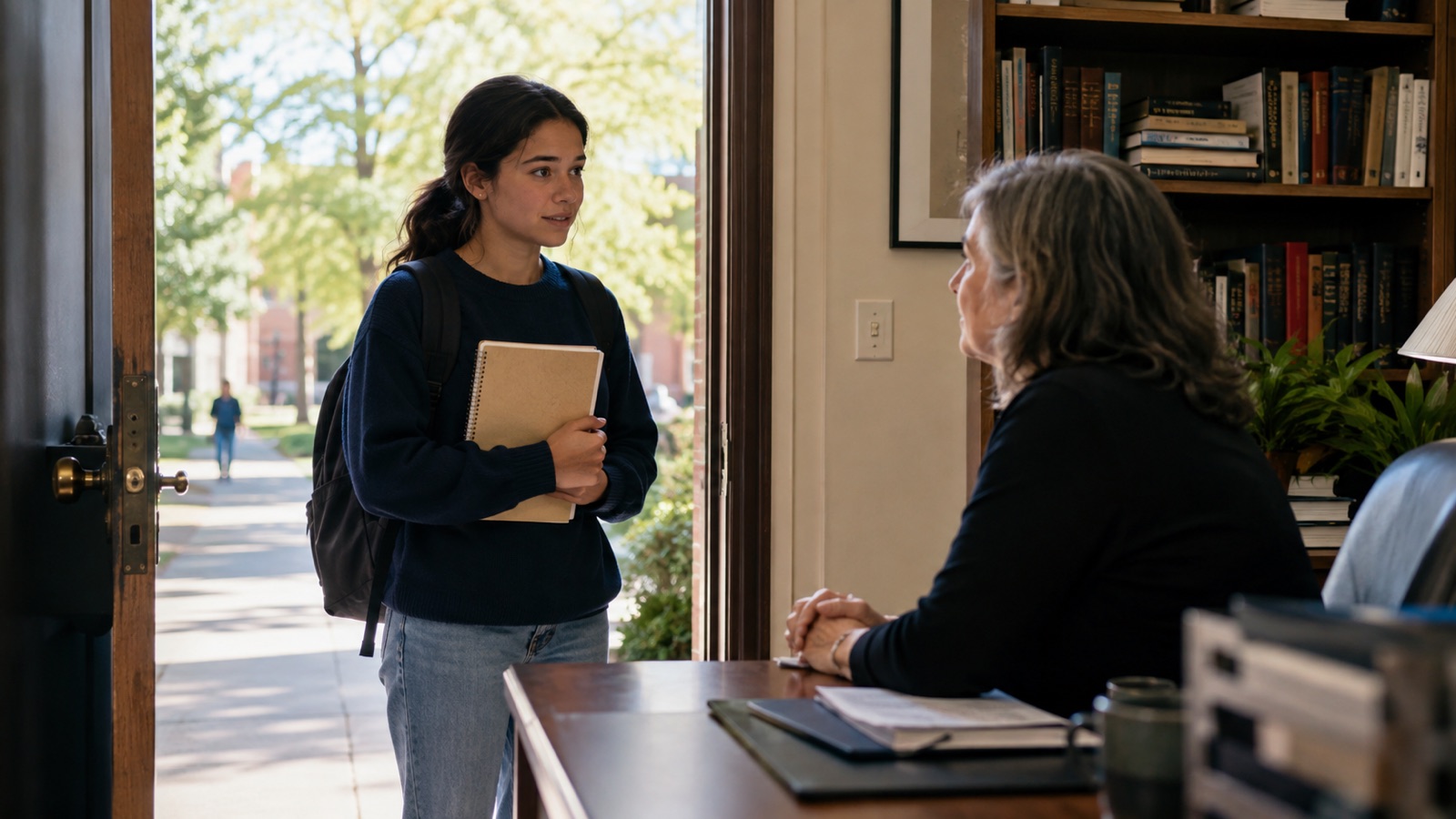
If attendance is slipping, contact the professor or teaching assistant early. You don’t owe a full clinical history. Try: “I’ve been dealing with a health issue that’s affected attendance. I’m working on support and want to re-engage. Could we clarify what I’ve missed and the most important next step?”
Ask one concrete question. Which assignment matters first? Is there a recording or note set? What’s the attendance consequence? Can you come to office hours? The goal isn’t to erase every absence. It’s to replace uncertainty with accurate information.
Avoid the apology dissertation. Shame may insist that you explain your moral worth before requesting a syllabus detail. You can be accountable and brief. If the answer is disappointing, it’s still more useful than the version anxiety has been drafting without evidence.
Campus support is easier to use before the cliff
College counseling, student health, an academic adviser, dean of students, case management, tutoring, or a disability-access office may each solve a different part of the problem. Counseling can address anxiety. An adviser can explain course options. Disability services can describe the documentation and adjustment process when a mental health condition substantially limits a major life activity.
Postsecondary students generally have to identify themselves to the appropriate office and request academic adjustments; professors aren’t expected to guess. What’s reasonable depends on the student, course, program requirements, and school process. Ask the office directly rather than relying on a roommate’s story from another department.
Support isn’t the same as removing every difficult situation. A good plan protects access while helping you engage with the education you came for. Sometimes that includes flexibility. Sometimes it includes a structured return. Sometimes the honest decision is dropping a course or considering leave, but that choice deserves information about deadlines, tuition, aid, housing, insurance, and re-entry.
Check whether anxiety is the only fire
Seek a clinical evaluation when avoidance is spreading, panic is frequent, sleep has collapsed, substances are becoming the main coping strategy, or you can’t keep up with eating, hygiene, medication, or basic responsibilities. Depression, ADHD, trauma, bipolar symptoms, substance use, sleep disorders, and medical conditions can overlap with anxiety and change the plan.
Get urgent help if you haven’t slept for several nights and feel unusually energized or out of control, you’re hearing or seeing things others don’t, you can’t care for yourself, or you’re thinking about harming yourself. In the United States, call or text 988. If there’s immediate danger, call 911 or go to an emergency department.
Missing class may be the visible problem, but safety and health come first. A semester can be repaired, repeated, or re-planned. You don’t need to protect the transcript by hiding a crisis.
Try a one-doorway experiment today
Write down one class anxiety has been shrinking. Complete three lines: “I predict...” “My smallest approach is...” and “The person I’ll contact is...” Your approach might be walking into the building and sitting for 10 minutes. Your contact might be one two-sentence email.
You’re not promising perfect attendance forever. You’re reopening one doorway that anxiety has been guarding. A small return plus honest support is often more powerful than waiting to become a different, magically unafraid student.
The bottom line: Anxiety-driven skipping can become self-reinforcing because absence brings relief. Name the exact fear, choose a manageable return, communicate early, and use campus or clinical support before the problem compounds. If your safety or basic functioning is at risk, get prompt help first.
Sources: Pittig and colleagues, review of avoidance in anxiety treatment, Behaviour Research and Therapy (2018); Craske and colleagues, review of inhibitory learning in exposure therapy, Behaviour Research and Therapy (2014); Finning and colleagues, systematic review of anxiety and school attendance, Child and Adolescent Mental Health (2019); U.S. Department of Education Office for Civil Rights, Academic Adjustments for Postsecondary Students.
How do you ask a professor for help when anxiety says hide?
A short message can reopen the academic conversation.

Should you take a mental health leave from college?
How to plan for care, money, and a return.

Why avoiding anxiety makes your world smaller
How short-term relief can quietly strengthen the fear.
Is anxiety shrinking your semester?
A free 15-minute intro call can help you decide whether psychiatric care fits the next step.