Study tips for the ADHDer that actually work.
Studying with ADHD when the textbook is the most boring object in the known universe. Evidence-based study strategies built for an ADHD brain, not against it.
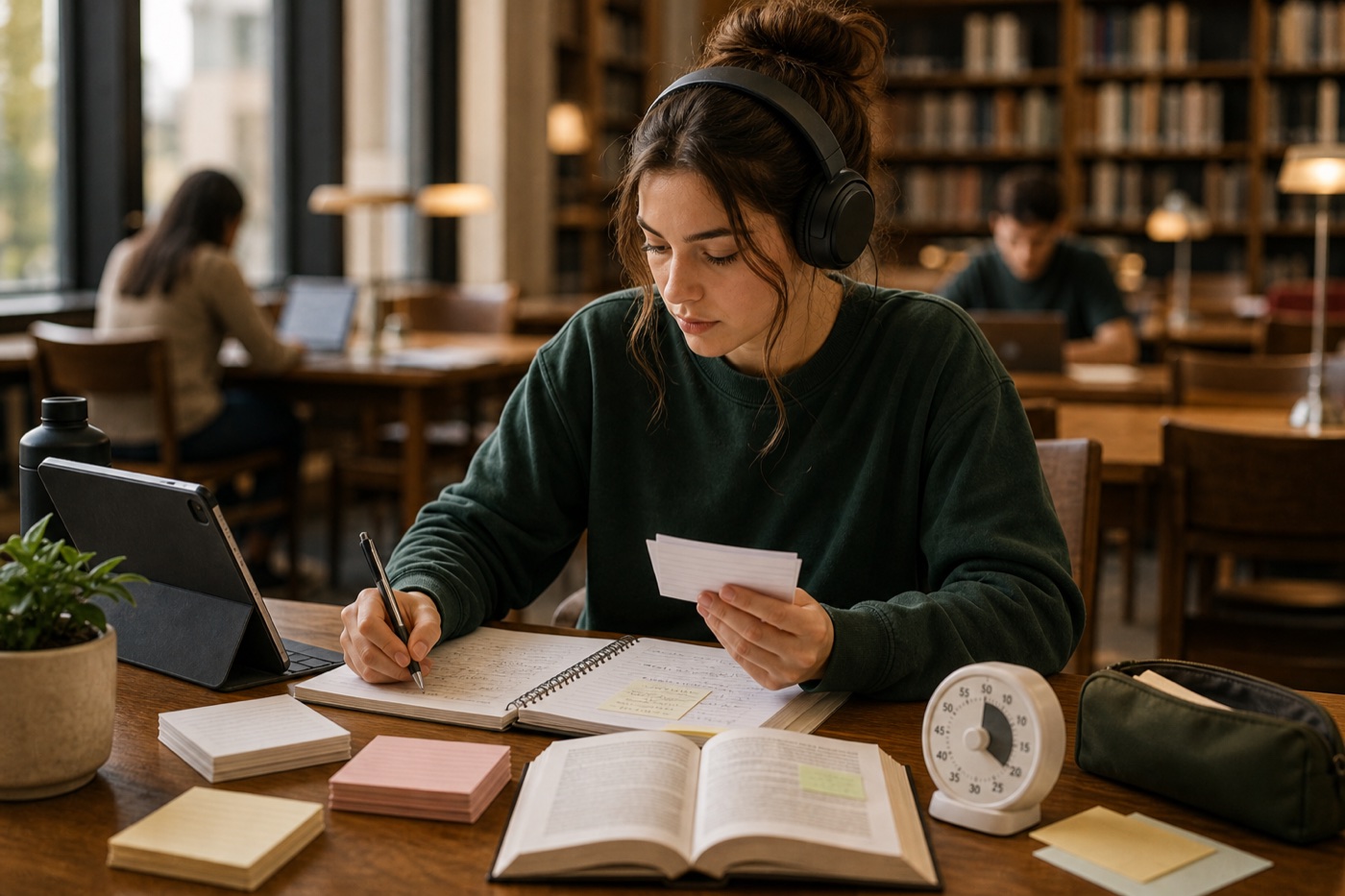
- Standard advice ("just focus," "reread your notes") is basically useless for an ADHD brain. It's built for a brain you don't have.
- The heavy hitters: active recall, spacing it out, short timed sprints, learning out loud, body doubling, and exiling the phone.
- Sleep beats cramming. Your brain files memories overnight, so trading sleep for one more hour usually nets you less.
- If you're doing everything right and still can't get traction, that's a clue worth an ADHD evaluation, not a character flaw.
It's 1 a.m. The exam is at 9. The textbook has been open to the same page for forty minutes, you have reread the same paragraph six times, and you couldn't tell me a single word it says. But you do now know the entire backstory of a stranger's sourdough starter on your phone. Congratulations, I guess.
Studying with ADHD is a special kind of torture. You sit down, open the book (officially the most boring object in the known universe), and your brain immediately files for divorce and starts dating the ceiling fan. Here's the thing nobody tells you. It's not that you're lazy or stupid. It's that almost every study tip you've ever been handed was designed for a brain that runs on quiet willpower, and yours runs on novelty, urgency, and dopamine. Different engine. Different fuel.
So let's stop trying to white-knuckle a brain that doesn't respond to white-knuckling. Here's what actually works, and a little on why.
Quit rereading. It's lying to you.
Rereading your notes feels amazing. Your eyes glide over familiar words, everything looks recognizable, and you close the book convinced you know it. You don't. You've just confused "I've seen this before" with "I can produce this on demand." Those are wildly different skills, and the exam only tests the second one.
The fix is active recall: close the book and force yourself to retrieve the answer from memory. Flashcards, a blank sheet you fill from scratch, explaining the concept out loud to your dog. It feels worse, because it's harder and you bump into what you don't know. That discomfort is the entire point. Retrieving information is what burns it in. Recognizing it does almost nothing.
- Close the book first, then quiz. If you can answer with the page open, you haven't learned it. You've copied it.
- Write the answer before you check it. The gap between your guess and the real answer is where the learning lives.
- Make the cards annoying. One fact per card. "Explain X" beats "X is ___."
Space it out. Cramming is a sugar high.
One eight-hour death march the night before feels productive and heroic. It's neither. The information goes in fast and leaves just as fast, usually somewhere around question three.
Three thirty-minute sessions across three days will beat that all-nighter and leave you less of a husk. Letting a little forgetting happen between sessions, then dragging the material back, is exactly what tells your brain "this matters, keep it." It feels less satisfying because you're not pulling an epic stunt. You're just quietly winning.
Sprint, then break (the 25-and-5)
"Study all day" is a sentence that makes an ADHD brain lie down on the floor. Of course it does. There's no finish line, so why start.
So shrink it. Twenty-five minutes on, five minutes off. A bounded sprint with a visible end is infinitely less terrifying than an open-ended slog, and a ticking timer manufactures the gentle urgency your brain craves to actually engage. Set a real timer. When it goes off, you stop, even mid-sentence. The hardest part is starting, and "just 25 minutes" is a much easier door to walk through than "the rest of your life."
- Protect the break. Stand up, get water, look out a window. Doomscrolling isn't a break, it's a trap with a five-minute fuse.
- Stack a few, then a longer rest. Three or four sprints, then go outside and be a person.
Make it loud, weird, and physical
Passive equals sleepy. If studying looks like sitting very still and staring respectfully at a page, your brain has already left the building.
So make it move. Stand up. Pace the hallway while you recite. Rewrite the concept in your own (ideally dumb) words. Teach it out loud to an imaginary class of confused freshmen. Doodle the process as a diagram. When you put information through your own hands and mouth instead of just your eyes, it sticks far harder. Looking a little unhinged in your room is a small price for actually remembering the thing.
Study near a human (body doubling)
This one sounds too simple to work, and it works anyway. Body doubling just means doing your task in the quiet presence of another person who's doing theirs. A library, a friend on a silent video call, a coffee shop full of strangers who'll never know they're load-bearing.
You don't talk. You don't collaborate. Something about another human nearby quietly makes starting and staying possible in a way that white-knuckling alone just doesn't. Don't overthink why. Just borrow the focus.
Exile the phone. For real.
Your phone isn't a neutral object sitting politely beside you. It's an engineered slot machine that several thousand of the smartest engineers alive built specifically to vaporize your attention. Face-down on the desk isn't far enough. It's right there, humming, lying to you about how strong your willpower is.
Put it in another room. A different room than your body. Yes, it feels dramatic. The point is to add enough friction that grabbing it becomes a decision instead of a reflex. Out of arm's reach, out of mind, and suddenly that paragraph stops needing six attempts.
Sleep is studying. Don't trade it away.
I know the math feels obvious: more awake hours equals more study hours equals better grade. The brain doesn't work like that. A lot of memory consolidation, the part where today's cramming actually becomes tomorrow's knowledge, happens while you're asleep.
Trade sleep for one more hour of bleary, half-absorbed rereading and you usually come out behind: foggier, more impulsive, and worse at retrieving everything you spent all night "learning." A rested brain on exam morning beats an extra hour of zombie studying basically every time. Go to bed. That's the tip.
The bottom line. Active recall, spaced sessions, short timed sprints, learning out loud, a body double, and a phone in another room will do more than any amount of willpower, because they work with your brain instead of against it. And if you're running every one of these and still can't get traction, that's not a willpower failure, it's a clue. It might be worth an ADHD evaluation, because the right treatment is what makes these tools finally click. Either way, you're not broken and you're not lazy.
Note: these strategies reflect well-established findings from cognitive and learning science, including the testing effect (active recall) and spaced practice. They're general study methods, not a treatment plan. Retrieved 2026-05-29.
How to actually get things done with ADHD
Productivity advice is built for other brains. Here's what works with yours.

Why routines are hard with ADHD (and how to build one that sticks)
It's not a discipline problem. Here's a routine that survives an ADHD brain.

The only personality model scientists actually trust
Those four-letter "type" quizzes are basically horoscopes with extra steps. The Big Five isn't.
Smart and still struggling? That's a clue.
Ask about an ADHD evaluation on a free 15-minute intro call.